
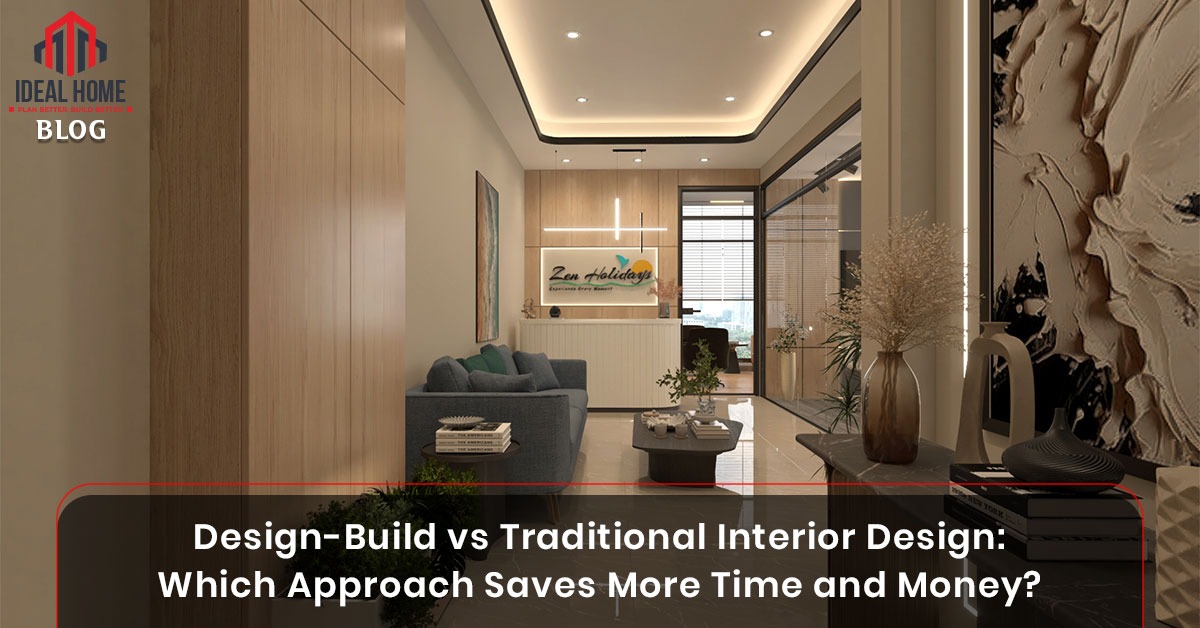
Design-Build vs Traditional Interior Design: Which Approach Saves More Time and Money?
Today, property owners have two primary options: the traditional interior design approach and the Interior Design-Build approach. When planning a commercial office, luxury home, retail store, healthcare facility, or hospitality space, one of the first decisions you will face is choosing the right project delivery method.
Most clients focus on design styles, furniture selections, finishes, and budgets. However, the way your project is managed can have an even greater impact on cost, timeline, and overall success.
At first glance, both methods may seem similar. After all, both involve designers, contractors, suppliers, and project execution. However, the structure behind each method is completely different.
The traditional model separates design and execution into different phases handled by different teams. In contrast, Interior Design-Build combines design, procurement, and construction under one integrated team.
As construction and renovation projects become more complex, many businesses and homeowners are asking an important question:
Which approach saves more time and money?
The answer depends on your goals, project complexity, and desired level of involvement. In this guide, we will compare Design-Build vs Traditional Interior Design and explore which model delivers better results in terms of efficiency, communication, project management, and overall value.
Interior Design-Build is an integrated project delivery method where a single company manages the entire process from concept development to project completion.
Instead of hiring separate designers, contractors, suppliers, and project managers, clients work with one team responsible for every stage of the project.
The Design-Build Project Delivery process typically includes:
Because all services operate under one roof, communication becomes simpler and project coordination improves significantly.
The primary goal of Interior Design-Build is to create a seamless workflow that reduces delays, minimizes misunderstandings, and improves cost control.
Traditional interior design follows a more fragmented approach.
In this model, the client first hires an interior designer to create concepts, drawings, and specifications. Once the design phase is complete, contractors are invited to submit bids and execute the project.
Although this method has been used successfully for decades, it often creates gaps between design intent and construction execution.
A typical traditional interior design process includes:
Because different parties manage different stages, clients often become responsible for communication and coordination.
This increases the need for active Interior Design Project Management throughout the project lifecycle.
But still, many offices are in old layouts. In turn, employees become inactive and the space may become cramped or uninteresting. The daily activity is also affected by insufficient lighting and inadequate planning. So, businesses are now seeking for better solutions. They wish they have designs that enhance work and are professional. This is where the trends of the interior design of an office become important in twin cities.
Here, in this blog, we’ll discuss the new changes in office design. Additionally, we will witness how these trends will enhance the working environment. Along with this, we will be discussing some smart ideas that can facilitate businesses with better spaces. So, let’s get started, and find out what is important in modern offices today.
The Twin Cities office space market is evolving in a straightforward and straightforward manner. The spaces that businesses are looking for today are open, clean and easy to use. This is leading office interior design trends in twin cities towards minimal and smart layouts. Businesses have shifted from decoration to functionality.
First, it is very popular to have open layouts. They facilitate team communication, teamwork. Furthermore, natural light is used more to lighten and freshen the space. This helps to boost mood and lower stress. Simple colors and light furniture are also a popular choice for many companies. Consequently, offices are more relaxed and productive. The changes have become a major key element of Twin City office interior design trends these days.
Furthermore, flexible design is increasing as well. Offices need to be able to easily transform from meeting rooms to team spaces or quiet work areas.
Key trends include:
So, these trends are not just about looks. They are about making work easier, faster, and more comfortable every day.

The key difference lies in responsibility.
In a traditional project, the designer and contractor operate independently. If issues arise during construction, each party may point to the other for clarification.
With Interior Design-Build, there is only one point of accountability.
The same team responsible for designing the space is also responsible for executing it.
This creates stronger alignment between vision and implementation.
As a result, clients spend less time managing conflicts and more time focusing on business objectives or personal priorities.
Time is one of the most valuable resources in any renovation or fit-out project.
Delays can affect business operations, rental income, occupancy schedules, and overall project costs.
In most cases, Interior Design-Build delivers projects faster than traditional methods.
The reason is simple.
Design and construction teams collaborate from the beginning rather than working sequentially.
During traditional projects, the process often follows this pattern:
Each stage requires additional time and approvals.
In contrast, Design-Build Project Delivery allows certain activities to overlap.
While designs are being finalized, procurement planning and construction preparation can already begin.
This integrated workflow reduces idle time and accelerates project completion.
Some common time-saving advantages include:
For clients with strict deadlines, Interior Design-Build often becomes the preferred choice.
Budget control is another major concern for homeowners and businesses.
Many clients assume that separating design and construction creates competitive pricing advantages.
While this can sometimes be true, it does not always lead to lower overall project costs.
Traditional projects frequently encounter unexpected expenses due to:
Because contractors join the project after the design phase, they may identify practical challenges that require modifications.
Every modification introduces additional costs.
With Interior Design-Build, construction professionals contribute during the design stage.
This early collaboration helps identify budget concerns before execution begins.
Benefits include:
Over the life of a project, these savings can be substantial.
Firstly, the turnkey design eliminates the need for numerous contractors. One business is responsible for design, planning and execution. This is to save time and stress on business owners. Besides, it reduces errors, as it is all performed in a single system. Consequently, work is speeded up and is more organized. The trend of interior design in offices in twin cities is now getting a strong thrust through this.
Furthermore, businesses favor turnkey solutions, as they let them have offices prepared for use without any delay. It also provides a better control on cost, as everything is planned in advance.
Main benefits include:
So, turnkey office interior design in twin cities is not just a service. It is now a smart way to build modern offices that match today’s fast business needs.
Office design in DHA Islamabad is emerging as a promising business hub in Twin Cities. Here are several companies establishing their headquarters. This is where you can easily see the trend in office interior design in twin cities. Modern, clean, and professional office spaces are highly desirable among businesses here.
The first thing to note is that offices in DHA have a special attention given to premium design. They employ quality materials such as wood, glass and metal. Moreover, layouts are designed in a simple yet very professional manner. This helps to make a strong impression on clients. This means that the design of interior decor of offices is here more on the amalgamation of style and functionality.
Also, office space planning plays a crucial role in DHA offices. Spaces for meetings, work stations, reception areas may be required in a single configuration. So, when it comes to designers, they just attempt to level everything in a sensible manner.
Common features in designs are:
So, office design in DHA Islamabad is not only about beauty. It is also about building trust and showing a strong business image.
Office interior designers in Bahria Town Islamabad has emerged as a fast developing commercial hub. There are a number of small and medium-sized businesses establishing offices here. Twin cities office interior design is also influencing the planning of office spaces because of this. Practical, sensible, and low cost designs are required for businesses in the area.
Function is the first thing that comes to mind when talking about Bahria Town office spaces. Businesses want to make the best use of available space. Therefore, the designers develop basic and effective layouts. They also don’t get overly adorned or embellished. This will make the workplace simple to manage and enjoyable to work in. In this regard, office interior design trends in twin cities are becoming more functional.
Further, it is extremely significant to customize. Each business is unique and layouts are customized according to their workflow and size. This will help increase productivity and comfort.
The following are common design priorities:
So, office designers in Bahria Town focus on creating practical spaces that support business growth without high cost or complexity.
Ideal Home has a strong influence on contemporary offices in Twin Cities. Office interior design trends in twin cities are constantly evolving and businesses should have spaces that look good, but are also functional. At Ideal Home, we concentrate on both! The aim is to create office spaces conducive to real work, rather than looks and alluring appearances.
The first step that Ideal Home takes is to get to know how a business operates. It’s important to remember that every company is unique. Others require open areas to work collaboratively. Others require privacy in their work. Therefore, the design begins with the knowledge of workflow, team size and the requirements for the day. Due to this, the final design is in line with real usage. This ensures that the office interior design trends in twin cities have a greater impact and effectiveness in real life.
Ideal Home then brings modern concepts to life in the form of spaces. This includes neat layouts, smart space utilization and modern materials. There is also thoughtful consideration given to lighting and furnishings. This means that offices are comfortable and productive. The designs are aligned with the office interior design trends in twin cities and yet satisfy business needs.
Key execution focus:
Finally, Ideal Home offers complete office solutions. Businesses do not need to manage multiple teams. Everything is handled in one place.
Services include:
So, Ideal Home makes office setup simple, fast, and aligned with modern needs. It helps businesses follow office interior design trends in twin cities in a practical and easy way.

Poor communication remains one of the leading causes of project failure.
Traditional projects involve multiple stakeholders who often work independently.
A client may need to coordinate conversations between:
This creates opportunities for confusion and delays.
By contrast, Interior Design-Build establishes a unified communication structure.
Everyone works toward the same objectives and follows the same project roadmap.
This collaborative environment improves efficiency and reduces misunderstandings.
Effective Interior Design Project Management is critical to project success.
Traditional projects often require clients to monitor multiple contracts and coordinate different service providers.
This can become time-consuming and stressful.
With Interior Design-Build, accountability is centralized.
There is one team responsible for:
This simplifies the client experience while improving project oversight.
Although Interior Design-Build offers many advantages, traditional interior design is not always the wrong choice.
Some clients prefer greater control over contractor selection and procurement decisions.
Traditional delivery may work well when:
In these situations, traditional methods can still produce excellent results.
However, success often depends on strong project management and active client involvement.
For most modern commercial and residential projects, Interior Design-Build provides a more efficient solution.
It is particularly beneficial when:
Because ideal homes design and execution are integrated, projects often move faster and experience fewer disruptions.
When comparing Design-Build vs Traditional Interior Design, the evidence increasingly favors the Interior Design-Build model.
The integrated nature of Design-Build Project Delivery reduces communication gaps, improves collaboration, streamlines procurement, and enhances project efficiency.
While traditional methods still have their place, they often require more coordination, longer timelines, and greater client involvement.
For businesses, homeowners, developers, and organizations seeking predictable outcomes, faster delivery, and stronger budget control, Interior Design-Build has become the preferred project delivery method.
As the interior design industry continues to evolve, integrated solutions are helping clients achieve better spaces with less risk, fewer delays, and greater overall value.
Ready to start your next interior project? Contact Ideal Home today to discuss your requirements and discover how our Design-Build approach can save you time, reduce costs, and deliver exceptional results.
Interior Design-Build is a project delivery method that combines design, procurement, construction, and project management under one team.
In many cases, yes. The integrated approach reduces rework, minimizes delays, and improves cost forecasting.
Because it improves communication, reduces project risk, and accelerates project completion.
Interior Design-Build typically requires less client involvement because one team manages the entire project.
Yes. Commercial offices, retail stores, healthcare facilities, hospitality spaces, and corporate environments often benefit from Interior Design-Build solutions.
IDEAL HOME | All Rights Reserved | Powered By The Velocity Digital Marketing